
The Master of Technology in Computer Science and Engineering (M.Tech in CSE) program is an advanced two year postgraduate journey designed to develop high level technology professionals, researchers, and innovators. The program strengthens advanced computing knowledge while enabling students to solve complex technological problems through research driven and industry relevant approaches.
Candidates must have successfully completed a Bachelor degree in Computer Science and Engineering, Information Technology, or a related discipline from a recognized university, securing a minimum of 55% marks. Relaxation is provided for reserved categories as per applicable norms.
Admission is subject to university norms and regulatory guidelines as applicable.
| Fees Structure | Amount |
|---|---|
| 1st Year Annual | 80000/- INR |
| 2nd Year Annual | 80000/- INR |
M.Tech Admission Procedure
At Future University, admission to the Master of Technology (M.Tech) programme is conducted through a transparent, merit-based, and research-oriented selection process designed to identify technically strong, analytically sharp, and innovation-driven engineers.
This programme is meant for those who want to go deeper - into design, optimization, systems thinking, advanced analytics, and applied research.
Admission Pathways for M.Tech
Admissions are offered through one or more of the following routes:1. Qualifying Examination Merit
• Admission based on marks obtained in the B.E. / B.Tech. degree
• Merit list prepared according to university norms and specialization eligibility
2. National & State Level Entrance Examinations
Candidates may secure admission through recognized entrance examinations such as:
• Graduate Aptitude Test in Engineering (GATE)
• State-level postgraduate engineering entrance examinations (as notified by respective authorities)
Valid scores and ranks are considered as per university guidelines.
3. FUCET – Future University Common Entrance Test
Future University also conducts its own entrance examination:
• FUCET (Future University Common Entrance Test)
• Designed to assess technical knowledge in the relevant discipline, analytical ability, and research aptitude

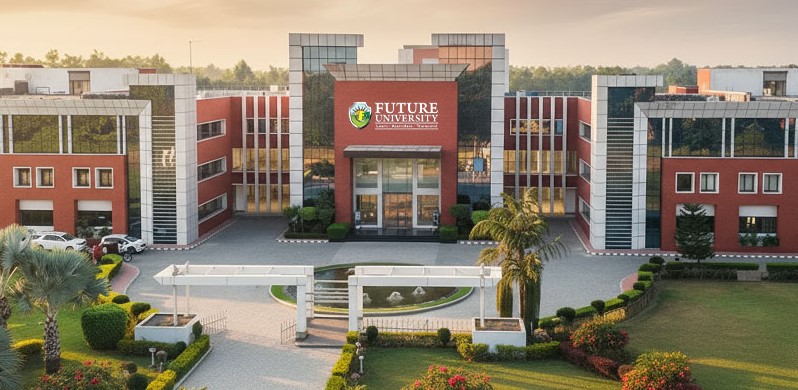
Future University stands apart through its research driven postgraduate curriculum, strong emphasis on innovation, and commitment to advanced technical excellence. With modern infrastructure, research opportunities, and structured placement support, the university prepares students to become future ready technology leaders and researchers.
• Industry aligned postgraduate curriculum
• Strong focus on research and innovation
• Advanced computing labs and research facilities
• Startup and incubation support
To nurture highly skilled computer science engineers who are innovative, ethically responsible, and capable of advancing technology through research, development, and leadership. The department strives to foster analytical excellence, scientific inquiry, and lifelong learning, empowering students to contribute meaningfully to technological progress and digital transformation at a global level.
High-demand roles across global tech industries
₹8 to 12 LPA
Design and develop complex software systems while leading technical teams and ensuring scalable solutions.
₹10 to 15 LPA
Develop advanced machine learning models and intelligent systems for automation and predictive analytics.
₹9 to 14 LPA
Design and manage large scale data architectures to support analytics and data driven decision making.
₹8 to 15 LPA
Conduct advanced research and contribute to innovation in artificial intelligence, computing systems, and emerging technologies.




















• Build advanced expertise in computer science and engineering principles
• Prepare students for leadership roles in software development, research, and innovation
• Deliver an industry aligned curriculum integrating theory with research and practical application
• Develop critical thinking, analytical skills, and research capability
• Provide hands on exposure to emerging technologies, advanced tools, and research practices
• Industry aligned postgraduate curriculum
• World class research and computing infrastructure
• Research oriented and innovation driven learning approach
• Expert faculty and industry researchers as mentors
• State of the art computing laboratories
• Faculty with strong academic and research experience
• Internship and research project opportunities
• Strong placement support and career guidance
• Advanced Algorithms and Data Structures
• Artificial Intelligence and Machine Learning
• Big Data Analytics and Data Engineering
• Cloud Computing and Distributed Systems
• Cybersecurity and Information Assurance
• Advanced Software Engineering
• Research Methodology and Technical Writing
• Internet of Things and Smart Systems
• Emerging Technologies and Innovation

Where Intelligence Meets Innovation